
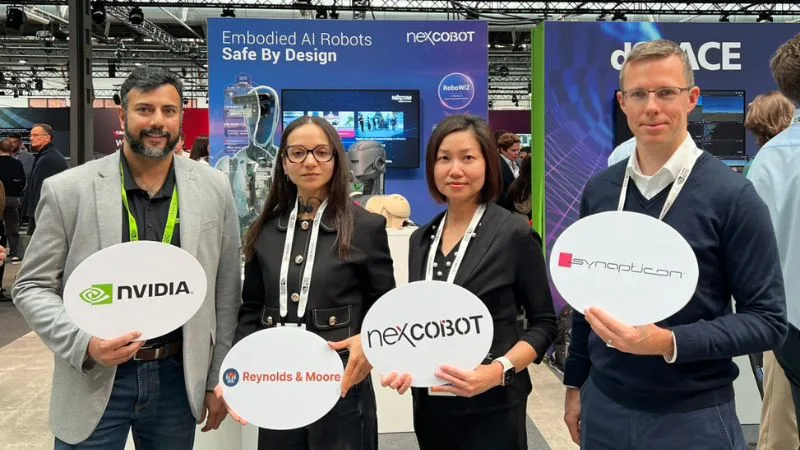
NEXCOM and its robotics subsidiary NexCOBOT have introduced the RoboWIZ AI Robotics Platform to an international audience at NVIDIA GTC Berlin, expanding their open ecosystem designed to streamline edge artificial intelligence and physical automation development. First demonstrated at Automation Taipei, the platform establishes a collaborative framework that links NexCOBOT controllers with vision sensors, motor drives, functional safety subsystems, and application software from specialized technology suppliers.
Developing advanced robotics—spanning humanoid platforms, quadruped units, dual-arm systems, and autonomous mobile robots (AMRs)—presents severe system-level integration bottlenecks. Engineering teams typically struggle to interface compute-intensive AI inference workloads with deterministic, millisecond-level motion control while adhering to strict machinery safety directives. RoboWIZ resolves this architectural divide by dividing robot development into five functional disciplines: AI core control, functional safety and cybersecurity, visual perception, real-time control, and actuation systems. Instead of enforcing a fixed system topology, the ecosystem allows developers to mix and match computing hardware from silicon providers including NVIDIA, Intel, and Qualcomm.
At GTC Berlin, NEXCOM highlighted four core ecosystem partners that extend RoboWIZ across critical machine interfaces. RealSense and Stereolabs provide depth cameras and 3D computer vision pipelines for navigation and spatial tracking. Synapticon contributes EtherCAT-based servo drives and SOMANET motor control modules, while Reynolds & Moore delivers functional safety engineering services and validation support. Paul Schmitt, Chief Technology Officer of Reynolds & Moore, observed that because robotics safety depends heavily on operational environments and risk reduction, NexCOBOT’s MARS400 T20 controller provides a modular foundation by pairing processing throughput with hardware-level safety design and validation flexibility.
The hardware cornerstone of the showcase is NEXCOM’s MARS400 T20 controller, architected around the NVIDIA IGX Thor platform. Powered by NVIDIA Blackwell GPU architecture and T5000-class specifications, the system features eight GMSL camera inputs to process high-throughput multi-modal vision streams without saturating host communication channels. By integrating accelerated computing silicon directly alongside real-time control kernels and dedicated safety islands, the controller processes complex AI reasoning models while maintaining deterministic bus cycles for multi-axis motor actuators.
For the electronics and embedded systems sectors, the launch reflects the transition of edge computing from isolated industrial PCs toward integrated physical AI fabrics. As factory floors, automated warehouses, and healthcare environments adopt collaborative machines, unifying silicon engines, machine vision, and certified motor control onto standardized development platforms lowers hardware development risks. By decoupling hardware modularity from vendor lock-in, NEXCOM’s open ecosystem accelerates the deployment cycle required to bring high-performance robotic hardware into commercial volume production.