
As India’s semiconductor sector expands toward ambitious future milestones, MosChip stands out as a key enabler. During the discussion, the executives spotlighted their flagship innovation—the VIDYUT100, an indigenous three-phase smart energy meter IC accompanied by a robust DLMS software stack. Designed to replace historical import dependencies, this solution directly supports the vision of Atmanirbhar Bharat and Viksit Bharat by powering critical smart city metering initiatives for electricity, water, and gas.
Beyond smart energy infrastructure, MosChip is deeply invested in high-performance computing (HPC) as a beneficiary of the National Supercomputing Mission (NSM), developing advanced System-on-Chips (SoCs). As India’s only listed fabless semiconductor company, MosChip leverages its robust talent pool, extensive analog design expertise, and dedicated training initiatives through MAST to bridge critical industry gaps. This conversation underscores how domestic design capabilities and strategic ecosystem collaborations are successfully positioning India as a global semiconductor powerhouse.
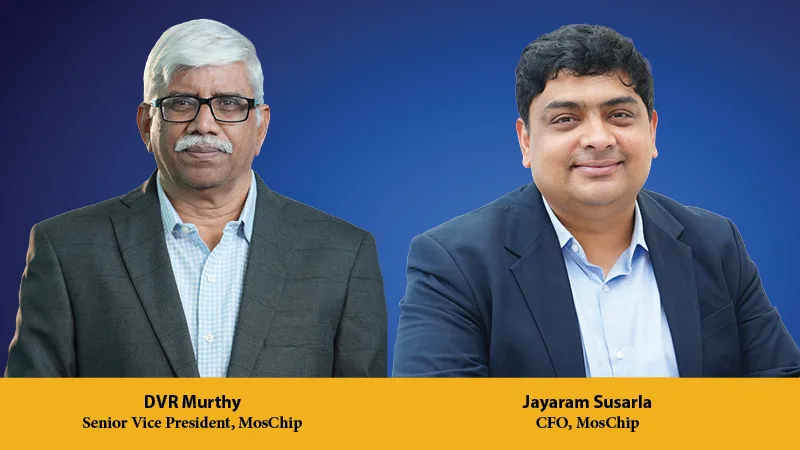
India’s high-tech manufacturing landscape is undergoing a monumental transformation, and at the forefront of this evolution is MosChip Technologies. In a recent interaction with Vaishali Chauhan, Jayaram Susarla (Chief Financial Officer) and D.V.R. Murthy (Senior Vice President, Strategic Programs) shared compelling insights into the company’s pivotal role in shaping the nation’s semiconductor ecosystem. Speaking live from SEMICON India 2026, the leadership team highlighted how government initiatives and surging global participation have created a thriving environment for indigenous innovation.
How Semicon India been for your company so far, what kind of response have you received from visitors and customers and what are some of key conversations happening at the event?
Thank you for the question. See, first of all, thank you so much to the government, MIT, for setting up a forum like this.
Because, as rightly said yesterday in the opening ceremony, the Minister and Narendra Modi, everyone said that, you know, this year we see around 650 stalls; last year we had around 300 or 350. So, essentially, it has literally doubled, and we also have visitors from 28 countries. So, this has become an event by itself, and if you go and look at Hall A and both in Hall B, you will find companies that are not only in the semiconductor domain, but the whole of the ecosystem is being addressed over here.
So, that only informs us that, you know, there is a good landscape which is being developed. And the point number two is we are working on high-performance; we are one of the beneficiaries of the National Supercomputing Mission (NSM. So, in June 2024, we got a contract from the government and CDAC to work on the high-performance computing system.
It’s called a system-on-chip. Okay. So, along with that, I think DVR Murthy, our IP strategy head, has also made, what do you call, smart energy meter chips, which he will probably talk about and explain to you. That is the main item which we are showcasing in this demo, in this event.
What are you showcasing at Semicon India and what are some of the key solutions or developments you would like the industry to know about?
So, basically, at Semicon India 2026, we are demonstrating one of the flagship items for MosChip, that is the chip known as VIDYUT100, which is a three-phase smart energy meter IC, which we developed at MosChip and getting showcased and demoed in this booth to multiple customers that are interested in knowing its features.
So, smart energy meter is a very big market and historically, the Indian OEMs use the chips that were imported; Our chip mostly meets the same requirements and satisfies all the compliance and certification and this is one of the major chip that is developed from, came from MosChip and more to that is actually the stack, the DLMS stack and the software around it, which MosChip is supporting, providing and for the whole India and for the Viksit Bharat or Atmanirbhar Bharat, we wanted to ensure that this stack is supported by MosChip for the next 10 years, so that more and more applications around smart energy meters will be developed. So, this is going to be a MosChip ‘s contribution for Atmanirbhar Bharat.
As we all know, India’s semiconductor ecosystem is developing rapidly and what opportunities you are seeing in the Indian market and what do you see the strongest potential of your company?
The first question is, as you rightly said, the market is expanding; that is very nicely visible in the exhibition, right? In all one and two, if you see, there are a lot of other companies that are there other than the semiconductor domain also.
So, basically, what the government is trying to do is help us enable the ecosystem to be built. There are a lot of OSATs coming up, there are a lot of packaging companies coming up, there are a lot of Fabs coming up. So, essentially, this means that the ecosystem will be developed and the second piece is, as they told in the meeting, inaugural, that the global market currently by 2030 is expected to be 2 trillion and essentially Indian market is going to be 1 trillion.
So, this only calls for a lot of manufacturing, which will happen within the country and we will have a lot of design opportunities and especially with chip like we chose and government of India want to automate the, what you call, the energy all across because there is a lot of efficiency that will be taken care. So, I think the opportunity will be there and along with that, as I told you, we are also working with the government on HPC SoC. So, that will also enable us with a lot of skills.
And just to give you a note, we are the only fabless listed company in India, and today we have our operations in four different cities plus the USA and we have around 2000 employees, which is 32% women, and the average age of our employees is around 28 years, and if you note, the average age of the country is in and around that space. So, as I rightly told you, we have the skill, we have the talent, and the government is enabling us thanks to the whole of the ecosystem, and we have a market training centre which is called MAST. So, it will help us in building a talent pool.
It is a 15-year-old institute. So, we have a few professionally trained academics plus a few PhDs in the institute who actually train our students, and these are the people who come. So, this is another way of giving back to society.
What are some key challenges you are seeing in India’s semiconductor ecosystem today and what role can industry players like your company play in addressing them?
So, we think the Indian ecosystem needs a lot of support, mainly in terms of analogue design, which is very much lacking in India and IP. IPs are the reusable blocks that we call in the semiconductor space for us to develop multiple chips. So, in the next few years in India, we see that a lot of OSAT companies are coming, FAPs are coming, and so the whole landscape is going to change.
To support this landscape, a lot of IP needs to be developed within India, coupled with more analog specific. So, MosChip role is basically in developing and making this IP available at affordable cost to the Indian startups and also to closely collaborate and work with them so that multiple chips can be developed out of India in the next four to five years so that India becomes self-reliant on the chip part of it and multiple applications for the domestic part of it and a lot of manufacturing initiatives within Indian ecosystem. So, we definitely see MosChip’s role, and we do our bit in this whole area.
How do you see the semiconductor industry in India evolving over the next few years and what are your priorities for the Indian market?
Again, as I told earlier, the market is going to expand. A lot of electronics will be manufactured in India and packaged in India as we move forward, and what they call is the Indian semiconductor industry would be 110 billion. One of the presentations that was made yesterday at the inaugural and globally, it is growing by 60 per cent.
So, that impact will be there in India, and India will trail the world. The second piece is I think, because of the government initiative, the ecosystem is being built with the OSAT partners or the FAPs, whatever it is. Because there is a lot of work would be coming to design centre companies like MosChip with this VIDYUT100, whatever we have and with the analog expertise we have, we definitely see a great amount of opportunity. Plus, I am sure we will play a larger role because today, if you see in India with a particular 2000 headcount and Fabless and being listed in India, that gives a great advantage in terms of hiring and also retaining the employees.
As you already mentioned about VIDYUT100, so can you tell us more about VIDYUT100 for the audience?
This is VIDYUT100 and this is what we are demoing today in our booth and with the full DLMS stack software working on that and this is going to be what I can say is going to change one of the major smart city initiatives by the government of India and as a utility market, we are spaced into that.
So, the next things will be the meter, the measurement meter for gas and for water. So, this is the three utilities that residential people will predominantly use and these measurement of these things and the automatic transmission over the air without any manual intervention is part of the smart city initiative. So, we call a city a smart city only when these utilities really work without manual intervention; automatically will go and analysis happens on that.
Though these services effectively reach each and every individual without any disturbance, that means uninterrupted supply of water and gas is the primary requirement for any smart city. So, we are going to be part of the smart city initiative, and our chips are going to what future are going to come are more centred around that. Thank you.