
SEMICON India 2026, the fifth edition of the country’s premier microelectronics summit, concluded at Yashobhoomi in New Delhi, marking a decisive structural shift from foundational policy framing to active commercial execution. Centered around the theme “Silicon to Systems: Building the Ecosystem,” the three-day flagship conference brought together domestic and global industry leaders to accelerate the deployment of front-end fabrication, advanced packaging, design architectures, and specialized equipment across India’s electronics manufacturing landscape.
The exhibition demonstrated significant global integration, convening over 600 exhibitors, including approximately 300 international players and official delegations from 52 countries. Underscoring international supply chain alignment, the floor hosted six dedicated Country Pavilions representing major semiconductor hubs: Japan, South Korea, Malaysia, the Netherlands, Singapore, and Sweden. In parallel, 12 State Pavilions highlighted regional industrial incentives, infrastructure readiness, sub-fab utility planning, and dedicated manufacturing corridors. Across the three days, the event recorded 51,656 total registrations and a cumulative footfall of nearly 40,000 industry professionals, engineers, and researchers.
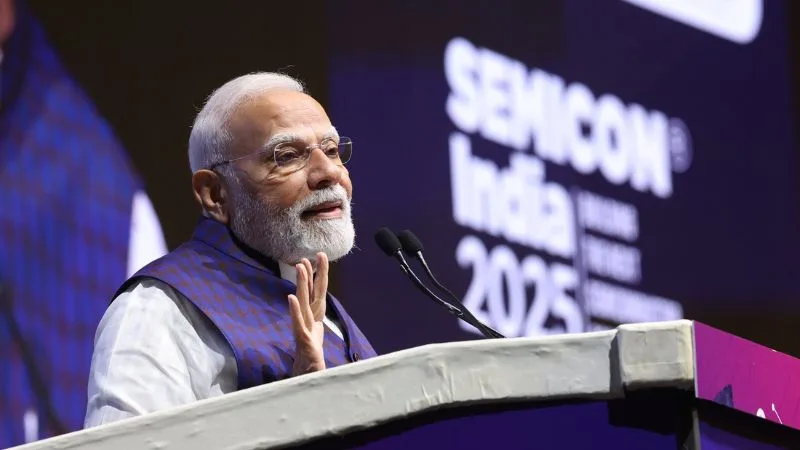
A defining milestone of the conference occurred during the inaugural address by Prime Minister Narendra Modi, who emphasized India’s tangible transition toward high-volume commercial manufacturing. Demonstrating operational progress on the factory floor, the Prime Minister virtually inaugurated commercial production lines at CDIL Semiconductor in Mohali and Suchi Semicon in Surat. These production milestones reflect real-world capacity creation in discrete semiconductor manufacturing and Outsourced Semiconductor Assembly and Test (OSAT) operations, signaling that domestic lines are qualifying wafers and delivering packaged components into active supply chains. Modi also engaged directly with student cohorts and chip design teams, reiterating the government’s push to align academic curricula with high-precision engineering requirements.
The summit served as a critical platform for commercial and technological dealmaking, yielding 56 strategic MoUs, commercial agreements, and joint development initiatives. The scope of these agreements reflected the technical breadth demanded by a self-sustaining semiconductor value chain. Beyond front-end silicon fabrication, commitments directly addressed key bottlenecks across advanced packaging (including 2.5D/3D architectures and system-in-package solutions), raw materials qualification, high-purity process gases, and capital manufacturing equipment.
Significant focus was directed toward power electronics, driven by escalating domestic and export demand for Silicon Carbide (SiC) and Gallium Nitride (GaN) devices in automotive electrification and grid applications. Concurrently, design-led partnerships emphasized the integration of artificial intelligence into electronic design automation (EDA) workflows and system-level architectures.
More than 150 industry speakers addressed technical sessions covering fab yield ramp-ups, metrology, cleanroom operations, and workforce skilling. By connecting multinational toolmakers, substrate vendors, state governments, and commercial cleanrooms, SEMICON India 2026 underscored that India’s semiconductor mission has progressed from capacity planning to volume manufacturing, establishing a comprehensive industrial footprint from raw silicon to deployment-ready systems.