
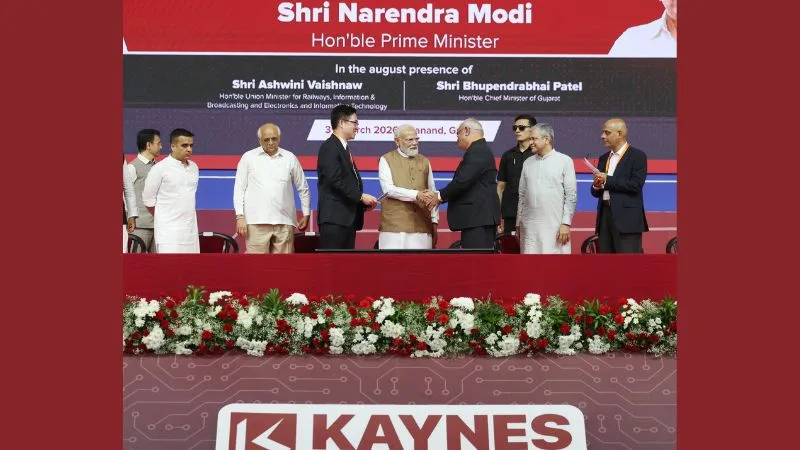
Prime Minister Narendra Modi inaugurated the Kaynes Technology semiconductor manufacturing facility in Sanand, Gujarat, marking the commercial launch of production at the site. The opening comes exactly one month after Micron commenced operations in the same industrial cluster, underscoring rapid progress in establishing Gujarat as a high-tech manufacturing hub under the India Semiconductor Mission (ISM).
The facility focuses on the assembly, testing, and packaging of power electronics, specifically Intelligent Power Modules (IPMs). These components are critical for regulating high-voltage power conversion and thermal dissipation in electric vehicle (EV) drivetrains, industrial motor drives, and heavy automation systems. The facility has already locked in substantial export commitments, including supplying a California-based technology firm, forging a direct component supply corridor between Sanand and Silicon Valley.
Nationally, the plant forms a key node in the broader India Semiconductor Mission, launched in 2021 to secure domestic hardware supply chains. Across the country, 10 major semiconductor fabrication and packaging projects worth over ₹1,60,000 crore are currently underway across six states. Alongside assembly capacity, domestic engineering is advancing at the logic layer, exemplified by the indigenous 64-bit “Dhruv” microprocessor designed for 5G telecommunications infrastructure, connected automotive electronics, and industrial control systems.
To expand beyond outsourced semiconductor assembly and test (OSAT) units, the central government has unveiled ISM 2.0. This next phase prioritizes upstream manufacturing, including localized production of specialized semiconductor manufacturing equipment, cleanroom materials, specialty chemicals, and substrates needed to build a full-stack domestic ecosystem.
Industrial growth is backed by upstream resource security and human capital initiatives:
Raw Materials and Critical Minerals: To counter global supply disruptions, India has joined the Pax Silica initiative and initiated the National Critical Minerals Mission. Complementary programs include a ₹1,500-crore scheme dedicated to mineral recycling and the development of a dedicated Rare Earth Corridor across the coastal belts of Odisha, Andhra Pradesh, Tamil Nadu, and Kerala.
Workforce and Design Infrastructure: Through the Chips to Startup (C2S) program, approximately 400 universities and research institutions have received access to industry-standard Electronic Design Automation (EDA) software, yielding over 55 tape-outs. The country is on track to train more than 85,000 specialized chip design engineers.
This expanding hardware foundation directly fuels India’s high-performance computing and Artificial Intelligence (AI) sectors. Sophisticated AI algorithms require specialized silicon architectures for low-latency inference, real-time edge processing, and intensive data center compute workloads. By manufacturing robust power modules locally and engineering proprietary silicon like the Dhruv core, India is building the baseline physical infrastructure required to deploy enterprise-grade AI across manufacturing, defense, and electric mobility.
India’s semiconductor market, currently valued at $50 billion, is projected to surpass $100 billion by 2030. The operationalization of the Kaynes facility highlights India’s shift toward high-value advanced manufacturing, positioning the country as an indispensable supplier in the global electronics ecosystem.