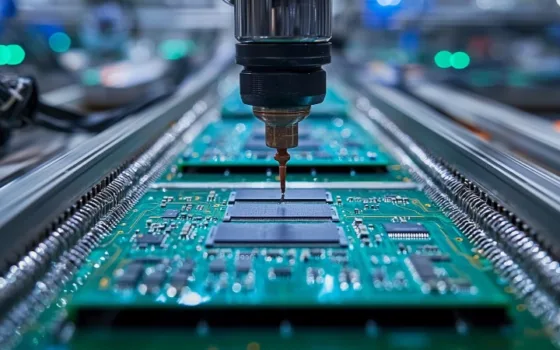


The global semiconductor market is projected to reach approximately USD 3.01 trillion by 2031, expanding at a compound annual growth rate of 24.9% from 2026 through 2031, according to a strategic research report released on ResearchAndMarkets.com. Grounded in full-year sales metrics compiled by the Semiconductor Industry Association (SIA) and World Semiconductor Trade Statistics (WSTS), the industry established a baseline valuation of approximately USD 791.7 billion in 2025. This performance represents a 25.6% year-on-year surge, marking a robust rebound from the cyclical downturn experienced in 2023.
Industry expansion is being propelled by accelerating capital deployment across artificial intelligence infrastructure and enterprise cloud architectures, alongside steady demand across smartphones, automotive platforms, industrial automation, and advanced consumer electronics. Data center investments dedicated to accelerated computing are expected to serve as the market’s primary engine throughout the decade. The rapid rollout of dense computing clusters continues to create unprecedented demand for advanced logic processors, high-bandwidth memory (HBM) stacks, high-speed networking components, and specialized power delivery solutions.
The study categorizes market revenue across seven foundational device segments: logic, memory, analog, microprocessors, discrete semiconductors, optoelectronics, and sensors. Among application categories, computing and data centers represent the primary growth driver, complemented by communications, consumer electronics, automotive electronics, and industrial sectors. Geographically, the report highlights thirteen countries across five regions, focusing on the core manufacturing and consumption hubs of the United States, Taiwan, South Korea, Japan, and China. These nations anchor critical competencies across microarchitecture design, front-end wafer fabrication, memory manufacturing, advanced lithography tooling, and outsourced backend packaging.
National industrial policies and cross-border trade dynamics are increasingly dictating manufacturing strategies worldwide. Government incentive frameworks, domestic fab support programs, supply-chain localization mandates, and tightening export controls are compelling chipmakers to reassess manufacturing sites and supplier relationships. Consequently, integrated device manufacturers and pure-play foundries are recalibrating fab capacity roadmaps to insulate supply chains against geopolitical friction.
Despite positive growth forecasts, the research outlines notable operational and macroeconomic risks. Over-reliance on a single demand driver—hyperscale AI infrastructure—exposes the market to capital-expenditure digestion cycles and memory pricing volatility. Furthermore, semiconductor producers and downstream OEMs face acute physical constraints,including power and clean energy availability for high-capacity facilities, specialized engineering talent shortages, and wafer fab equipment lead times. Balancing massive fabrication investments against supply chain concentration will determine how successfully chipmakers scale toward the USD 3 trillion milestone.