
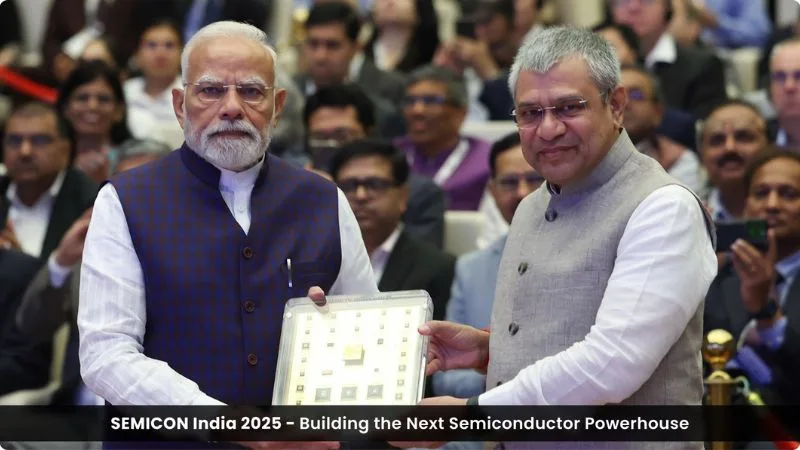
PM Modi inaugurated SEMICON India 2026 at Yashobhoomi in New Delhi, affirming that India is aggressively positioning itself as the world’s most trusted manufacturing hub for the global semiconductor supply chain. Addressing industry leaders, investors, and international delegations, he emphasized that amidst shifting global trade dynamics, India provides the long-term stability, policy backing, and technical talent that modern fabrication demands.
Building on the foundation of the initial semiconductor initiatives, the Prime Minister announced an expanded financial outlay of $13.5 billion under India Semiconductor Mission (ISM) 2.0, up from $8 billion in the first phase. The initiative has already cleared 12 major chip-manufacturing projects, with more approvals slated for rollout.
Union Electronics and IT Minister Ashwini Vaishnaw outlined the operational roadmap under ISM 2.0, identifying six industrial pillars:
- Semiconductor design and architecture
- Manufacturing equipment and raw materials
- Memory chip manufacturing
- Silicon, compound, and logic fabrication units
- Industrial-scale research and development
- Domestic design capacity targeting at least 200 startups
Prime Minister Modi noted that the explosive demand for Artificial Intelligence is shifting global chip fabrication beyond raw transistor density toward full-system packaging, heat dissipation, and advanced memory integration. This technological shift gives emerging manufacturing hubs a level playing field to build next-generation architectures alongside established foundry nations.
Highlighting India’s 7.8% GDP growth rate and recent sovereign rating upgrades by Japanese rating agencies, Modi called upon global chipmakers and domestic conglomerates to deepen their local R&D footprints. He urged domestic researchers and non-resident Indian technologists working abroad to anchor their work in India’s expanding fab ecosystem.
Organized under the theme “Silicon to Systems: Building the Ecosystem,” the three-day summit gathered over 600 exhibitors and 300 global enterprises across 50 nations. The venue featured six dedicated international pavilions—representing Japan, South Korea, Malaysia, the Netherlands, Singapore, and Sweden—alongside 12 Indian state pavilions competing to host supply-chain clusters, assembly facilities, and testing plants.