
A primary highlight of UST’s showcase at the event was its joint OSAT (Outsourced Semiconductor Assembly and Test) initiative alongside Kaynes Semicon in Sanand, Gujarat. The synergy pairs UST’s core expertise in silicon engineering, embedded systems, and packaginSemiconductor g with Kaynes’s electronic manufacturing scale. Furthermore, Mathew outlined UST’s push into smart manufacturing through humanoids tailored for industrial automation, alongside strategic design capabilities enhanced by acquiring a majority stake in Italdesign to build end-to-end AI products. Addressing ecosystem challenges, he emphasized that building a resilient domestic supply chain requires collaborative consortiums involving industry players, academia, and policymakers working as a unified entity.
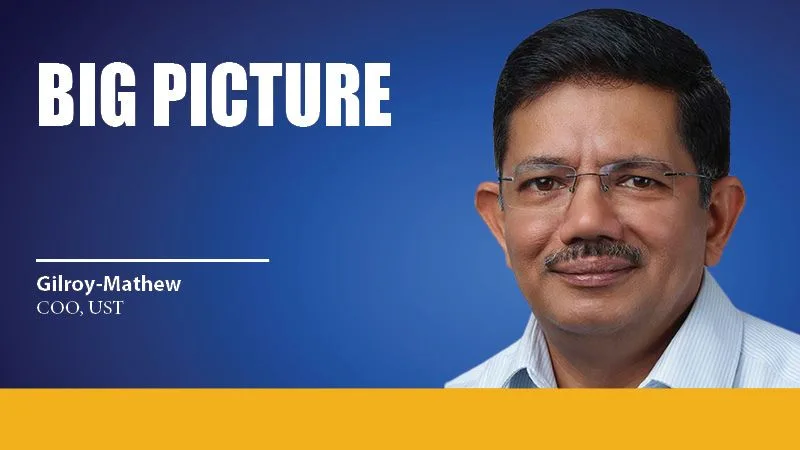
In a recent interaction, Vaishali Chauhan and Gilroy Mathew, Chief Operating Officer at UST, shared key insights on UST’s strategic advancements and the broader evolution of India’s semiconductor landscape during Semicon India. Highlighting India’s distinct advantage, Mathew noted that while global peers developed chip manufacturing capabilities prior to the artificial intelligence boom, India is building its semiconductor infrastructure with an “AI-first” approach from the ground up. This structural shift enables the nation to leapfrog traditional development cycles and pioneer next-generation indigenous systems without unlearning legacy frameworks.
How has Semicon India been for your company so far? And what kind of response do you receive from visitors and customers? And what are some of the key conversations happening at the event?
Sure, so if you really look at where we are today in Semicon India, it’s an extraordinary time that we are all living in. Because it’s a momentous occasion. Because we are actually living through an era of investments in semiconductors in India for the last few years.
And we are seeing the fruit of many of those investments in the last few years, right? So now, if you really look at that, all the investments that have already been done have already been shaped into a few of the OSATs, and now ATMs and others have already come in. And some fives are on the way. And big companies like us, as well as others, have already invested larger portfolios in Semicon and AI.
So that being the scenario, right? You need to really look at India as a unique advantage. Primarily because many of the countries that have invested in Semicon have already been in Semicon without AI. But we, in India, are developing the infrastructure for Semicon with AI.
And that is where it’s a rare opportunity for us because we don’t have to unlearn anything. We can do everything. In fact, some of the models that we need for tomorrow can be built first-hand from India itself right now.
So that’s the way I’m seeing it as India evolves into the semiconductor ecosystem. And again, if you really look at it, many of the countries would have taken like 20 years to get to where India is already. In the last 4-5 years, we have already invested, and we have improved to where we are today. And that is where we are seeing huge opportunity for growth.
What are you showcasing at Semicon India? And what are some of the key solution or developments you would like the industry to know about?
So, one, we already invested in the OSAT along with Kaynes in Sanand, Gujarat. So that’s the first where we are actually taking it to the next phase of growth. So that is definitely the biggest thing that we want to really take off.
And that’s also where UST is bringing in the strengths of our silicon engineering and embedded systems as well as packaging and AT. Whereas Kaynes is bringing in all the expertise from electronic manufacturing setup, and that is where the energy is. Now, secondly, we are also bringing in the humanoids that are required for various customers, especially from an industrialization standpoint, because that is the next leap of growth from manufacturing: a smart manufacturing setup.
Now, where we are today, we are definitely advancing at a much faster pace, and we will definitely be building it out of India. And in the coming months, that is one thing that we will be announcing. And the third thing is, we also took a majority stake in a world-famous design company called Intel Design.
And that also brings in world-class user experience and design capabilities. All of these will add together to really build the ecosystem because we need to really look at how we can actually evolve AI as a product. And that is where the workers, devices and systems will get the size and shape of what we need in India as an indigenous world.
India’s semiconductor ecosystem is developing rapidly. And what are the opportunities are you seeing in the Indian market, and what do you see as the strongest potential of your company?
India has always been a services-oriented location. But that is changing because if you really look at a few functional areas, right? If you take semiconductor from a design standpoint or semiconductor from a manufacturing standpoint or even from a supply chain standpoint, all these three areas are evolving in India.
And that is why, as I said earlier, we actually have an advantage because we are bringing in an AI-first approach towards semiconductor. And all these three areas will get a jumpstart because of the automation that we could bring in using AI. And that is why, even though today everybody talks about AI and it’s a cliché, we need to really see that this is much more than that. Because it is the essence of the momentous transformation, the way we live our lives.
What are some key challenges you are seeing in India’s semiconductor ecosystem today? And what role can industry players like your company play in addressing them?
The ecosystem has to evolve, and that is exactly what the government is doing. Because it’s definitely an investment-friendly country now for semiconductors.
And that’s why you see the huge number of companies coming and showcasing what they can bring to the table. So that itself is a huge plus. Now, what is it that we need to do more? And that is where more companies, the academics, the policymakers, everybody needs to constantly work together as one team.
Nobody can actually lift and fulfil this huge dream. And it’s a huge responsibility on our shoulders. That cannot be done overnight by a single player.
And that is where we are seeing a lot more consortiums coming in, a lot of partnerships coming in, to discuss and decide on what the next step is that can be evolved over the period of time. Everybody is working towards that kind of consortium model.