
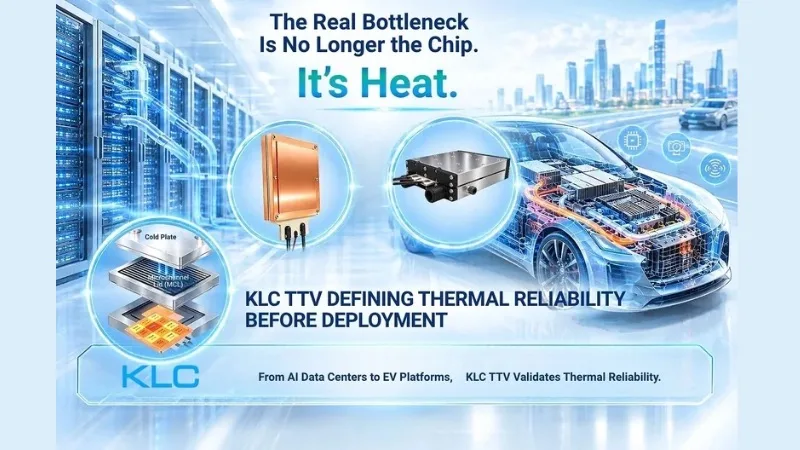
As deep learning workloads, multi-chiplet packaging, and high-density GPU clusters push modern computing architectures toward unprecedented power levels, thermal dissipation has emerged as a primary bottleneck in semiconductor development. To counter these challenges during physical implementation, KLC Corporation has introduced comprehensive Thermal Test Vehicle (TTV) technologies. These solutions simulate real-world thermal behavior directly at the wafer level, bridging the gap between schematic conception and physical cooling hardware.
During the chip-wafer layout design and planning phases, engineers face severe heat flux variations across die surfaces. KLC’s TTV architectures deliver precisely controlled, programmable heat sources that mimic the localized hot spots found in high-power compute dies, GPU platforms, and advanced 2.5D/3D packaging. By deploying test vehicles prior to full silicon fabrication, engineering teams can validate silicon floorplans, ensure balanced thermal expansion, and optimize power distribution grids without risking costly functional silicon redesigns.
Beyond wafer floorplanning, KLC’s TTV platforms serve as essential validation tools for liquid cooling architectures, cold plates, and direct-to-chip heat exchangers. Engineers can accurately model heat transfer resistance, evaluate junction-to-case temperature gradients, and measure coolant flow performance under simulated peak compute loads. This early-stage insight shortens prototyping cycles, minimizes design spins, and ensures high operational reliability for AI server infrastructure.
Complementing its semiconductor testing portfolio, KLC also expanded its presence in automotive thermal systems. The company showcased high-voltage coolant heaters designed for electric vehicle (EV) battery preheating and passenger cabin climate control. Supporting electrical architectures from 12 to 400 VDC with power outputs scaling up to 12,000 W, these PTC-based units provide rapid, energy-efficient heating in harsh operational environments.
According to KLC Corporation CEO Joanna Wu, thermal management has transitioned from a downstream packaging consideration into a core design requirement across both automotive and semiconductor sectors. By pairing precise chip-wafer thermal validation tools with heavy-duty vehicle heating hardware, KLC provides end-to-end thermal solutions capable of supporting the next wave of high-density AI hardware and electrified mobility.