
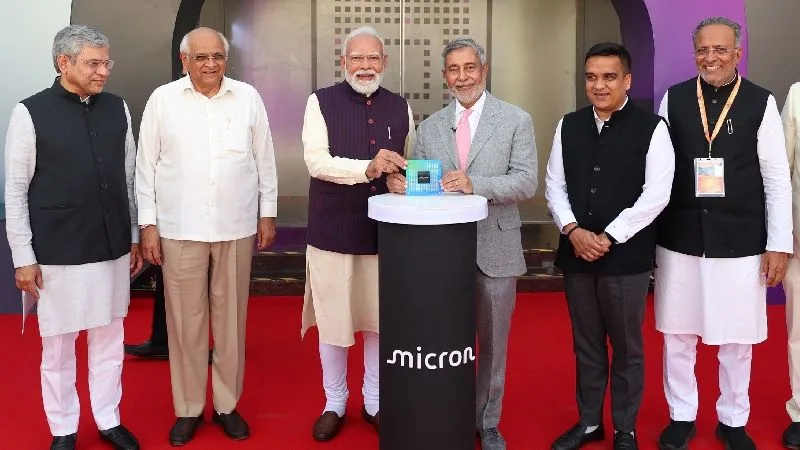
Prime Minister Narendra Modi has formally inaugurated Micron Technology’s semiconductor Assembly, Test, Marking, and Packaging (ATMP) facility in Sanand, Gujarat, marking the official commencement of commercial production. The operationalization of the high-volume facility represents a critical inflection point for India’s backend semiconductor manufacturing roadmap, transitioning national policy initiatives into high-volume domestic output.
The Sanand site executed an accelerated buildout timeline, progressing from the initial Memorandum of Understanding (MoU) signed in June 2023 and groundbreaking in September 2023 to machine tool installation by February 2024 and full commercial qualification in February 2026. This rapid transition was enabled by policy execution that streamlined regulatory workflows, including the clearance of Advanced Pricing Agreements (APAs) within months—a process that typically extends from three to five years across developed markets.
From an engineering and operational standpoint, the Sanand manufacturing plant houses one of the largest dedicated ATMP cleanrooms globally. Engineered around rigorous environmental and fab sustainability baselines, the facility utilizes advanced water recycling and resource-conservation infrastructure to support continuous backend operations.
The manufacturing lines will assemble, package, and test high-density DRAM modules and NAND flash memory storage products. These components serve critical high-reliability applications across automotive electronics, consumer devices, industrial embedded hardware, and enterprise data centers. In the broader computing landscape, these memory solutions provide the localized bandwidth and storage density necessary to support edge devices and infrastructure handling scaled artificial intelligence workloads.
The launch anchors Gujarat’s emerging semiconductor corridor, linking the manufacturing clusters of Sanand and Dholera. Beyond physical assembly lines, the ecosystem requires an extensive supporting value chain encompassing ultra-pure process chemicals, packaging substrates, lead frames, precision automated test equipment (ATE), and specialized cleanroom logistics. State policies simplifying industrial utility delivery, water networks, power stability, and land allocation have facilitated the localization of these upstream input industries.
Nationally, the facility serves as the initial anchor for the broader Semicon India initiative, which has approved 10 manufacturing projects across the country. Commercial production will expand across additional sites in Uttar Pradesh, Assam, Odisha, and Punjab. To sustain this momentum, the central government has outlined the India Semiconductor Mission (ISM) 2.0, expanding financial and structural support across the entire semiconductor supply chain—from raw materials, specialty gases, and equipment to advanced packaging and component distribution.
The project also deepens strategic bilateral manufacturing ties between India and the United States. Under initiatives like the Pax Silica framework, both nations are aligning to build resilient, redundant global supply chains spanning critical mineral extraction, front-end manufacturing, and backend packaging.
With domestic electronics manufacturing and export volumes multiplying over the past decade, the local integration of memory packaging reduces supply chain vulnerabilities for device manufacturers operating in India. The Sanand plant establishes an operational baseline for the domestic electronics ecosystem, shifting India’s semiconductor footprint from design-centric operations to commercial packaging and manufacturing delivery.