
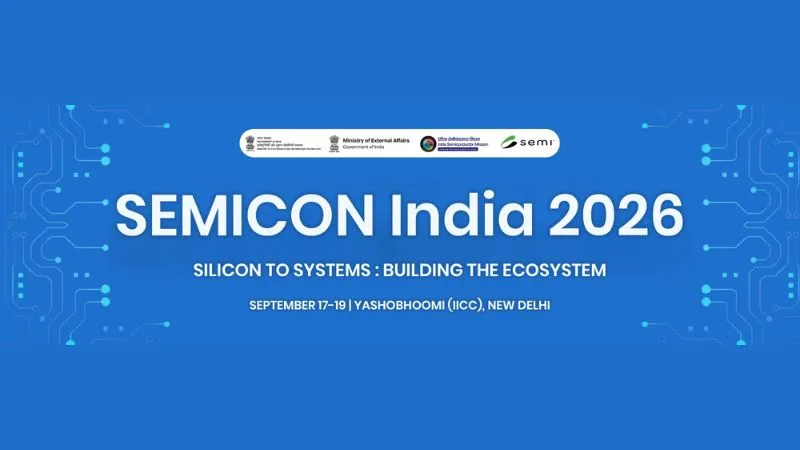
India’s semiconductor policy framework has shifted from capital sanctioning to industrial execution, with three manufacturing units now in commercial production and additional plants slated to become operational by the end of 2026. The progress under the India Semiconductor Mission (ISM 1.0) sets the technical stage for SEMICON India 2026, scheduled from September 17–19 at Yashobhoomi, New Delhi. Jointly organized by ISM, MeitY, and SEMI, the event gathers over 500 exhibitors and 240 international firms across 15,000 square meters.
The shift reflects on-ground capacity buildouts. Under ISM 1.0, 12 projects representing ₹1.64 lakh crore in cumulative investments were cleared. Operations are led by Micron’s ATMP unit in Sanand, alongside facilities from Kaynes Semicon and CG Semi, which have commenced outbound commercial packaging and export shipments. According to MeitY, India aims to reach five to six fully operational manufacturing sites before the close of the calendar year, providing proof of execution to global foundries, fabless vendors, and OSAT houses.
| Key Parameter | Current Status / Target Projection |
| ISM 1.0 Approved Units | 12 projects (₹1.64 lakh crore total capital outlay) |
| Operational Facilities | 3 running commercially (Micron, Kaynes, CG Semi); 5–6 by year-end 2026 |
| Front-End Fab Pipeline | 300mm wafer fab at Dholera (Tata-PSMC; 50,000 WSPM capacity targeted) |
| Domestic Chip Market | Projected to expand from ~$90B by 2030 to $200B by 2035 |
| SEMICON India Footprint | 500+ exhibitors, 240+ international companies, 40+ country delegations |
Industry stakeholders emphasize that addressing domestic silicon demand—projected to reach $90 billion by 2030 and $200 billion by 2035—requires resolving core supply chain vulnerabilities. While front-end cleanrooms like Tata-PSMC’s 300mm fab in Dholera scale toward a targeted 50,000 wafer starts per month (WSPM), the broader domestic ecosystem still relies heavily on imports for wet process chemicals, ultra-pure gases, and critical substrate materials.
SEMICON India 2026 will feature dedicated industrial tracks for Materials, Chemicals, and Gases alongside Equipment Manufacturing, aligning with the newly approved ₹1,27,500-crore Semicon 2.0 initiative to localize raw input supply chains and upstream tooling infrastructure.