
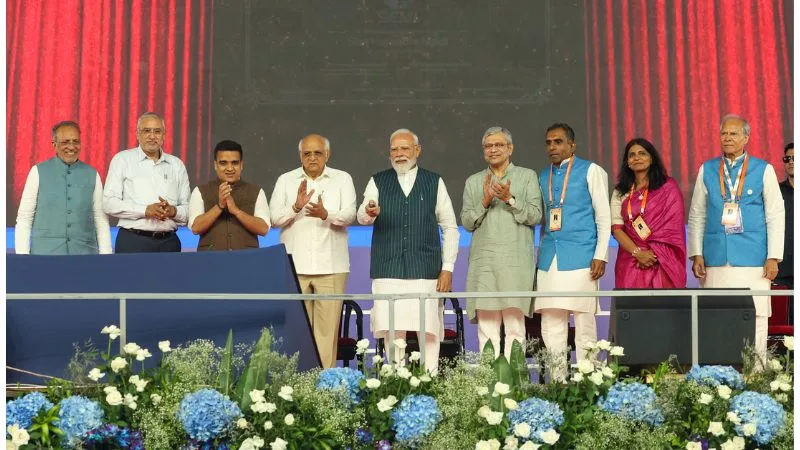
India’s semiconductor packaging footprint marked an operational milestone as Prime Minister Narendra Modi formally inaugurated CG Semi’s Outsourced Semiconductor Assembly and Test (OSAT) facility in Sanand, Gujarat. The plant represents the third major semiconductor manufacturing site in the region to transition into commercial operations, signaling a decisive shift from policy rollout to high-volume manufacturing (HVM).
The facility is an international joint venture bringing together CG Power and Industrial Solutions, Japan’s Renesas Electronics Corporation, and Thailand’s Stars Microelectronics. The collaboration combines Renesas’ microcontrollers, analog, and power semiconductor IP with Stars Microelectronics’ operational packaging expertise, providing a tested framework for domestic chip assembly, testing, marking, and packaging (ATMP).
Rapid Execution and Capacity Scaling
Following the foundation stone laying in 2024, the Sanand facility completed pilot testing cycles ahead of schedule. The site is now entering active commercial packaging with an initial run-rate capacity of 20 crore (200 million) units per year. CG Semi has outlined a structured scale-up plan to expand total volume to 500 crore (5 billion) units annually as production lines ramp up to meet domestic automotive, industrial, power, and consumer electronics demand.
Addressing industry stakeholders and project engineers, Prime Minister Modi emphasized the velocity of the project’s execution. He noted that moving from groundbreaking to commercial packaging within two and a half years demonstrates execution discipline and validates the “Design in India, Make in India” roadmap established under the India Semiconductor Mission (ISM).
Engineering a Clustered Ecosystem
A central theme of the launch was the transition from isolated assembly lines to a self-sustaining industrial cluster. Sanand is fast developing an integrated electronics ecosystem modeled after global tech manufacturing nodes such as Taiwan’s Hsinchu Science Park and Japan’s Tsukuba Science City.
With concurrent investments and pilot operations underway by Micron Technology, Kaynes Semicon, and CG Semi in close proximity, the corridor is attracting adjacent supply chain partners. These include:
-
Specialty Chemicals & Electronic Gases: Localized blending of ultra-pure wet chemicals, specialty precursors, and carrier gases essential for packaging lines.
-
Substrate & Lead-Frame Suppliers: Developing domestic tooling for advanced lead frames, organic substrates, and thermal interface materials.
-
Test & Failure Analysis Centers: Shared infrastructure for reliability testing, burn-in validation, and automotive qualification standards (such as AEC-Q100).
Securing the Value Chain for Next-Gen Tech
Prime Minister Modi highlighted that India’s domestic electronics production has expanded sevenfold since 2014, supported by an elevenfold growth in total exports. While the initial wave of growth focused on final-system assembly (box builds and smartphones), securing long-term resilience requires full vertical integration across raw wafers, critical minerals, packaging substrates, and embedded software.
The facility’s operational ramp-up also highlights specialized human-capital development. Project engineers and technicians—including women recruited from regional Industrial Training Institutes (ITIs) and trained at partner packaging lines in Southeast Asia—are actively operating modern surface-mount and wire-bonding cleanrooms. As domestic packaging capacity expands, the output will directly supply domestic power-electronics modules, automotive electronic control units (ECUs), and edge-AI hardware.