
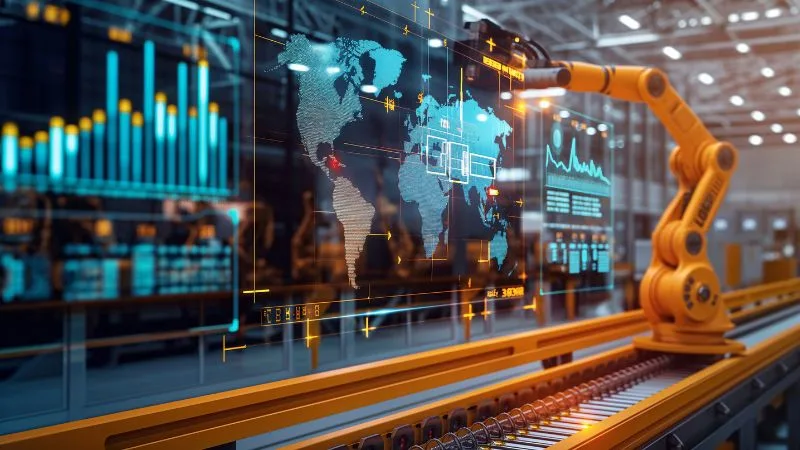
The global factory automation market, valued at $157.53 billion in 2025, is projected to reach $325.22 billion by 2035, progressing at a compound annual growth rate (CAGR) of 8.7%. The expansion reflects an ongoing operational transition across high-volume discrete and continuous process facilities, where manufacturers are deploying multi-axis robotics, industrial IoT, edge computing, and real-time supervisory systems to curb operating overhead and insulate shop floors from chronic labor shortages.
As industrial enterprises seek higher equipment utilization and agile floor plans, capital allocations are pivoting from isolated machine purchases toward integrated digital production environments. The industry is standardizing on programmable logic controllers (PLCs), distributed control systems (DCS), automated optical inspection, and plant-wide manufacturing execution systems (MES) capable of tracking material flow and machine health in real time.
Hardware and Software Architecture
Industrial robots remain the primary hardware segment by revenue, driven by high-speed handling, precision assembly, and dangerous material processing across automotive, aerospace, and electronics manufacturing. Concurrently, machine vision systems and connected sensor arrays represent the fastest-growing field equipment tiers. High-resolution optical inspection tools and edge cameras now handle in-line defect screening, part orientation, and robotic guidance, preventing flawed sub-assemblies from advancing downstream.
On the control side, supervisory control and data acquisition (SCADA) platforms and PLCs continue to anchor plant operations, providing the deterministic cycle execution and telemetry collection needed for factory floors. However, growth is shifting toward higher-tier software layers:
Manufacturing Execution Systems (MES): Connecting enterprise resource planning with machine-level controllers to balance dynamic shop-floor scheduling with live yield data.
Functional Safety & Asset Management: Embedding automated risk protocols alongside condition monitoring to extend mechanical component life and avert catastrophic line stoppages.
Regional Dynamics and Infrastructure Momentum
The Asia-Pacific region dominates global demand, commanding a 42.70% market share in 2025. Regional dominance is sustained by dense electronics manufacturing hubs, expanding semiconductor foundries, and extensive automotive assembly lines across East and South Asia. Recent regional milestones include Rockwell Automation and Cisco launching a software-defined manufacturing reference design in Gurugram, India, alongside ABB’s ongoing $75 million investment program to scale domestic industrial automation R&D and assembly hubs.
Europe follows with a 26.45% market share, supported by deep Industry 4.0 penetration and brownfield retrofits, such as Siemens expanding its Industrial Edge ecosystem with decentralized SCADA. North America holds 20.56%, shaped by accelerated investments in connected plants, reshoring initiatives, and rigorous operational technology (OT) cybersecurity frameworks to protect industrial controllers from network-level exploits.
Vendor Landscape and Strategic Focus
The supplier environment remains concentrated at the top while supporting a broad ecosystem of specialized hardware vendors. Siemens leads global market share at 15.0%, backed by its widespread deployment of Simatic controllers, industrial communications hardware, and digital enterprise software. ABB holds 12.0%, sharpening its focus on pure-play industrial automation and electrification following the divestment of its robotics business to SoftBank Group.
Rockwell Automation accounts for 10.0% through its Allen-Bradley control portfolio, software-defined industrial architectures, and cloud MES platforms. Schneider Electric captures 9.0% with its EcoStruxure automation stack, followed by Mitsubishi Electric at 7.0%, Honeywell International at 6.0%, Yokogawa Electric at 5.0%, Omron Corporation at 4.0%, and General Electric at 3.0%. The remaining 27.0% is distributed among specialized motion control, robotics, and sensor manufacturers including FANUC, Keyence, Yaskawa, Bosch Rexroth, and Beckhoff Automation.
As high-mix, low-volume manufacturing requirements become standard, factory automation is moving from static mechanical lines to software-defined production networks capable of autonomous process adjustments.