
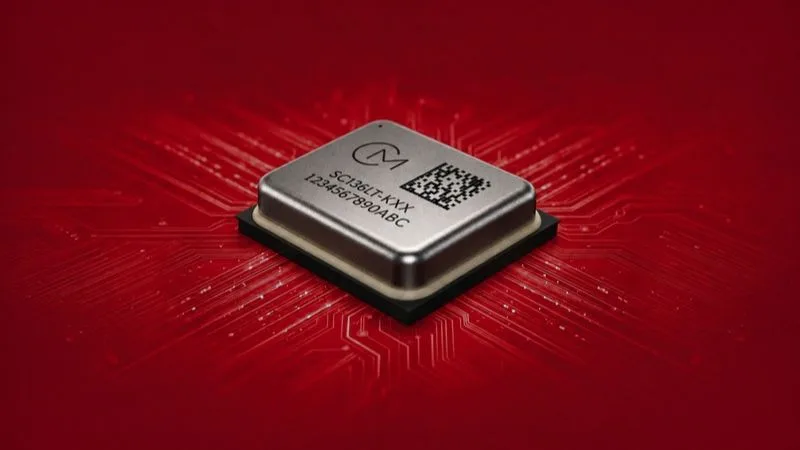
Murata Manufacturing Co., Ltd. unveils the SCI36LT Series, a range of highly integrated intelligent IMUs that incorporate high-performance six degree of freedom (6-DoF) MEMS sensors together with an embedded microcontroller (MCU). At introduction, the SCI36LT-K01 features the proprietary sensor fusion algorithm of Murata for accurate orientation sensing, whereas the SCI36LT-K02 is a customized platform that offers users the ability to load and run their own code on the embedded MCU. With the use of embedded MCU for orientation calculation, the SCI36LT-K01 cuts down host side processing and sensor fusion development efforts. On the other hand, the SCI36LT-K02 offers the flexibility to perform application-specific processing within the sensor component.
Conventional IMUs measure angular rate and linear acceleration, with the resulting sensor data subsequently processed by a host MCU or processor to determine the orientation of the monitored object. Developing this sensor fusion layer requires additional computing resources as well as specialized expertise in areas including algorithm implementation, sensor calibration, and system-level optimization.
Drawing on Murata’s vertically integrated expertise in MEMS, sensor fusion, electronics, and packaging, the SCI36LT family combines a high-performance MEMS sensor, an embedded MCU, supporting electronics, and passive components within a single compact platform. This enables sensor data processing to be moved closer to the sensing element, reducing the processing burden on the host and providing greater flexibility over how inertial data is used within the end system.
Two Launch Variants for Integrated and Custom Software
- SCI36LT-K01: Turnkey solution with proprietary Murata Software & algorithm. Combines Murata’s high-performance IMU with its proprietary sensor fusion algorithm, running on the integrated MCU to calculate pitch, roll, and relative yaw. The device combines a ±490°/s gyroscope with a ±16 g accelerometer and provides calculated orientation in either Euler angle or direction cosine matrix (DCM) format. Configurable algorithm dynamics and output data rates allow sensor behavior to be optimized for different motion profiles and system requirements.
- SCI36LT-K02: Open platform for Custom Software Development uses the same integrated IMU and MCU architecture but does not include Murata’s sensor fusion algorithm. Instead, customers can program the embedded MCU with their own software, allowing application-specific processing to be performed directly within the sensor component rather than on the host system.
For the SCI36LT-K01, integrated calibration features support module-level calibration after the sensor has been incorporated into the end system, simplifying compensation at PCB or module level. These capabilities make the SCI36LT family well suited to demanding industrial and robotic applications, including grade control for heavy machinery and excavators, dynamic inclination sensing in construction machinery and industrial equipment, support for real-time kinematic (RTK) positioning in surveying equipment and autonomous systems, motion sensing in humanoid robots, and commercial drones applications in agriculture, infrastructure and facility management, civil engineering and construction, and logistics.
Highly Integrated Architecture in a Compact Industrial Package
Measuring just 11.2 × 9.2 × 2.9 mm (0.44 × 0.36 × 0.11 inches), the SCI36LT family integrates Murata’s high-performance MEMS technology with an MCU, passive components, and crystal resonator in a single compact LGA package. This high degree of functional integration removes the need forminimizes the number of external components required and enables sophisticated inertial sensing to be incorporated into space-constrained system designs. The device supports 3.1 V to 5.5 V supply and operates across -40°C to +85°C temperature range, making it suitable for demanding industrial operating environments.
“The increasing sophistication of industrial and robotic motion-control systems is creating demand not only for high-performance inertial sensing but for greater processing flexibility directly at the sensor,” said Juhani Pelttari, Senior Manager, Business Development at Murata Europe. “By combining high-performance MEMS with embedded processing in a single compact platform, SCI36LT gives designers greater flexibility over where and how inertial data is processed, helping reduce integration effort at system level.”
The SCI36LT common platform will also form the basis of the broader product family and future application-specific sensor and software implementations. Future generations of the products will be able to use different algorithms and IMU calibration schemes depending on the needs of particular applications, making the platform scalable beyond the two initial launch platforms. The SCI36LT Series includes the SCI36LT-K01 and SCI36LT-K02. The samples are now available with mass production planned for Q1 2027.