
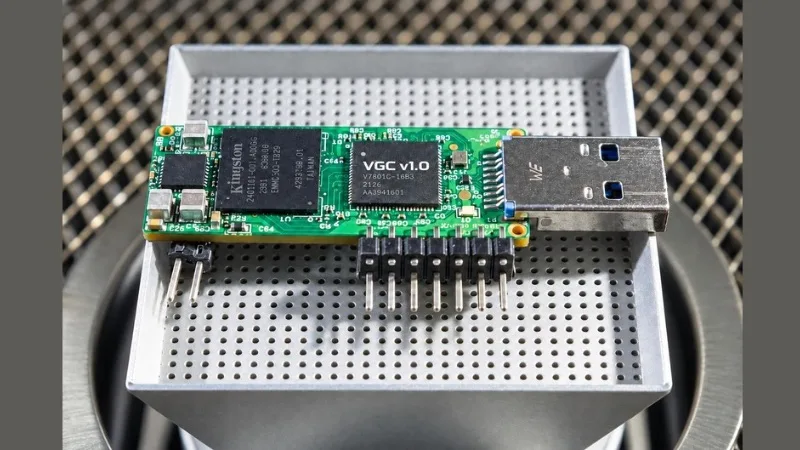
Vietnam’s Government Cipher Committee and military-run telecommunications enterprise Viettel Group have unveiled VGC v1.0, the nation’s first security processor to integrate a domestically engineered cryptographic algorithm directly into silicon. Developed concurrently with Vietnam’s first domestically designed secure semiconductor platform, the rollout marks a strategic advance in Southeast Asia’s microelectronics landscape. By shifting critical cryptographic functions from software layers to dedicated silicon, the initiative seeks to eliminate backdoors, reduce dependency on imported integrated circuits, and establish sovereign governance over sensitive data infrastructure.
Architecturally, the VGC v1.0 integrates 300 million transistors within a 10 × 10 mm package, fabricated on a 28-nanometre complementary metal-oxide-semiconductor (CMOS) process. Under rigorous benchmark evaluations, the hardware-level cryptographic engine demonstrated encryption and decryption execution speeds roughly 15 times faster than equivalent software-only implementations. The initial silicon batch successfully concluded technical qualification and achieved official certification for socio-economic deployments in the first quarter of 2026. Prior to foundry tape-out, proprietary technical safeguards were integrated into the layout to prevent net-list tampering, side-channel leakage, and reverse engineering.
The collaborative engineering workflow joined national security governance with commercial chip execution. The Government Cipher Committee’s specialized M2 unit established microarchitectural security specifications, synthesized the underlying cryptographic algorithm, and developed verification baselines. The Viettel Semiconductor Center executed physical design, logic implementation, and system tape-out. Built upon the open-source RISC-V instruction set architecture (ISA), the secure platform gives Vietnamese engineers architectural independence, allowing teams to scale compute cores, modify register pipelines, and reuse established verification methodologies across future processor iterations without third-party licensing constraints.
Initial hardware deployments have commenced in secure hardware security modules and encrypted USB drives across central party, administrative, and defence bodies. Future volume integration targets Vietnam’s national digital signature authentication network, which maintains more than two million active digital certificates. Beyond public governance, the processor is positioned to protect SCADA industrial controls and edge sensors across telecommunications, power grids, municipal water networks, and petroleum facilities.
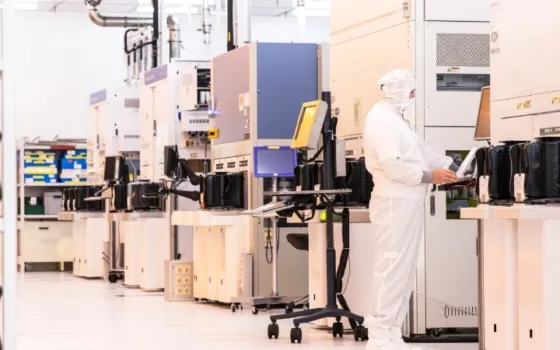
Lieutenant General Tao Duc Thang, Chairman and CEO of Viettel Group, stated that mastering secure semiconductors is a formidable discipline requiring sustained technical capability and elite engineering talent, underscoring that starting later does not mean accepting permanent foreign dependence. In parallel with signing agreements for volume production and multicore architectures, Viettel is building a semiconductor fabrication plant in Hoa Lac. The facility anchors Vietnam’s ambitions to transition from an outsourced packaging outpost into an integrated manufacturing power capable of domestic design, fabrication, and backend assembly.