
As the global demand for space infrastructure accelerates, the need to protect delicate space-bound electronics right from the assembly floor has never been more critical. Addressing this challenge, satellite communications company SES has chosen ABN Cleanroom Technology to design and construct a dedicated controlled-environment facility at its headquarters in Betzdorf, Luxembourg.
The upcoming facility focuses on securing the operational life of next-generation satellite payloads. In orbit, even a speck of dust can blind optical instruments, compromise precision sensors, or short-circuit high-reliability electronics. ABN’s turnkey project aims to eliminate these risks at the root by delivering a certified ISO Class 7 cleanroom specifically configured for satellite hardware integration and rigorous testing.
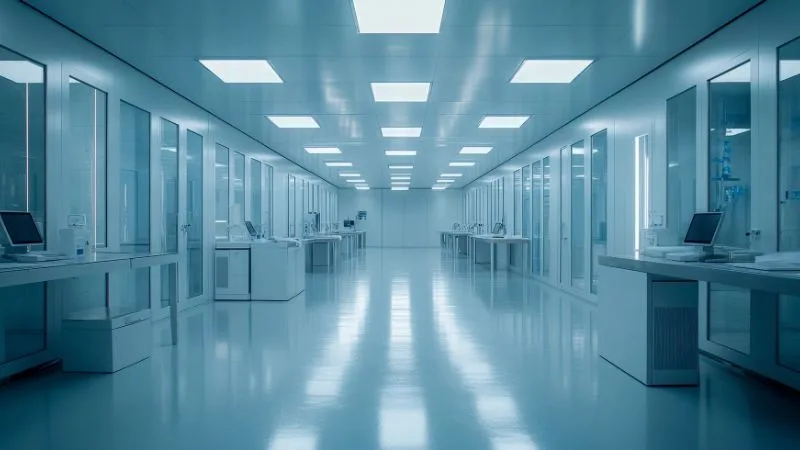
Covering roughly 100 square meters, the controlled environment will restrict airborne particulates to a strict ceiling of no more than 352,000 particles (0.5 micrometres or larger) per cubic metre of air. Beyond standard dust filtration, the facility integrates fine-tuned environmental controls. Temperature, humidity, and positive air pressure will be monitored around the clock to prevent material stress and ensure sensitive flight components remain stable during assembly.
ABN is handling the entire lifecycle of the facility on a full turnkey model. This scope encompasses concept design, detailed engineering, modular construction, dedicated HVAC air-handling units, high-efficiency filtration, electrical systems, and formal commissioning.
Central to the project is ABN’s proprietary ICONIC cleanroom platform. Initially engineered to meet the stringent contamination standards of microelectronics and semiconductor manufacturing, ICONIC relies on a prefabricated, modular architecture. For SES, the layout includes open integration zones and wide access points to accommodate large, fragile satellite assemblies without compromising airflow dynamics. The interior will feature seamless, flush-mounted wall and ceiling panels, engineered to prevent particle accumulation and simplify maintenance.
The modular approach also offers a key practical advantage: speed. By building core components off-site, ABN significantly cuts on-site installation time and reduces logistical disruptions at SES’s base. Furthermore, the plug-and-play setup allows SES to scale or reconfigure the cleanroom footprint as future mission demands expand, without needing to tear down existing infrastructure.
The contract underscores an expanding footprint for ABN Cleanroom Technology across critical European industrial sectors. While cleanrooms are standard in semiconductor fabs, their rapid adoption in the private space economy highlights how aerospace manufacturing is borrowing high-tech manufacturing discipline. The Luxembourg project adds to ABN’s recent work across the continent, which includes an aerospace cleanroom for Kreios Space in Spain, a life-sciences training facility for ViTalent, and hospital clean installations in Belgium.
With site work scheduled to begin shortly, the new facility will provide SES with the controlled baseline required to assemble and test advanced satellite hardware for upcoming orbital missions.