
X-FAB MEMS Foundry GmbH has officially received a €127.4 million grant notification to expand its manufacturing infrastructure in Erfurt, Germany. Presented by Thuringia’s Minister President Mario Voigt, Minister of Economic Affairs Colette Boos-John, and Erfurt Mayor Andreas Horn, the public funding backs the company’s “Fab4Micro” expansion project. The financial package comprises approximately €80.3 million from the German federal government and €47.1 million from the Free State of Thuringia, which stepped up its regional co-funding share to secure the initiative.
The project operates under the framework of the European Chips Act (ECA), having secured state aid approval from the European Commission in December 2025. Fab4Micro marks one of the most substantial industrial capital investments in Thuringia in recent years, directly serving the European Union’s broader objective to establish technological sovereignty and domestic capacity across strategic microelectronics segments.
Cleanroom Construction and Heterogeneous Integration
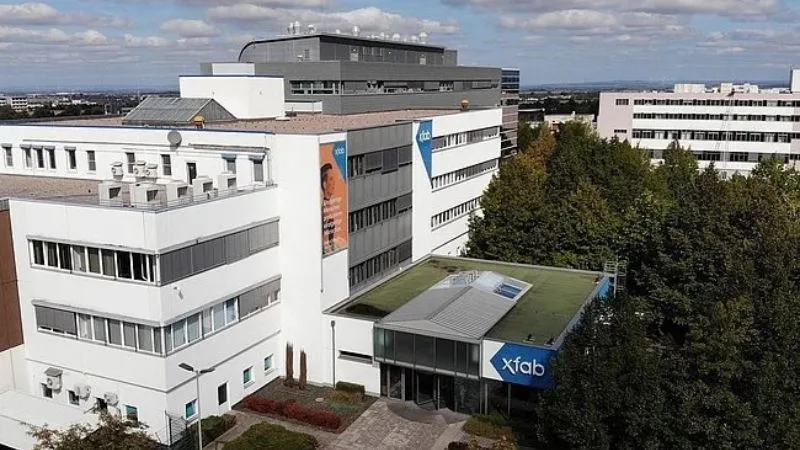
At the center of the capital expenditure is the construction of an advanced cleanroom facility at X-FAB’s primary Erfurt manufacturing campus. Initial commercial production inside the new cleanroom is scheduled to go online by the end of 2028.
The added cleanroom footprint will substantially scale X-FAB’s production capabilities for micro-electro-mechanical systems (MEMS), photonics, and highly integrated microsystems. Technically, MEMS devices combine nanoscale mechanical, sensing, and electronic structures on a single substrate, serving critical sensor architectures in automotive subsystems, mobile hardware, and precision medical devices.
Beyond standalone MEMS fabrication, the facility will introduce dedicated process capabilities for heterogeneous integration and advanced wafer-scale assembly. This packaging and integration pathway enables the physical consolidation of disparate electronic and optical dies into single, highly integrated multi-functional components. Such hybrid optical-electronic microsystems are critical for scaling bandwidth and lowering latency in high-speed optical transceivers, AI server clusters, and next-generation telecom data centers.
Open Foundry Access and the Thuringian Semiconductor Cluster
Operationally, the expansion reinforces Erfurt as X-FAB’s primary technology center of excellence for microsystems, a site where the pure-play foundry group began operations more than three decades ago. According to site leadership, the new capacity will deploy an open foundry model. This setup allows fabless technology firms, system integrators, and mid-sized European “hidden champions” to access commercial-scale wafer processing, MEMS surface micromachining, and advanced packaging without relying entirely on offshore fabrication lines.
The investment also solidifies Thuringia’s established microelectronics supply chain. The regional cluster encompasses more than 70 enterprises covering the entire semiconductor value chain—spanning integrated circuit design, prototyping, materials science, precision optical machinery, wafer handling, and backend volume packaging. By providing dedicated capacity for custom silicon, integrated photonics, and advanced sensor modules, the Fab4Micro cleanroom project directly anchors European manufacturing resilience in high-mix, high-reliability specialty semiconductor technologies.