

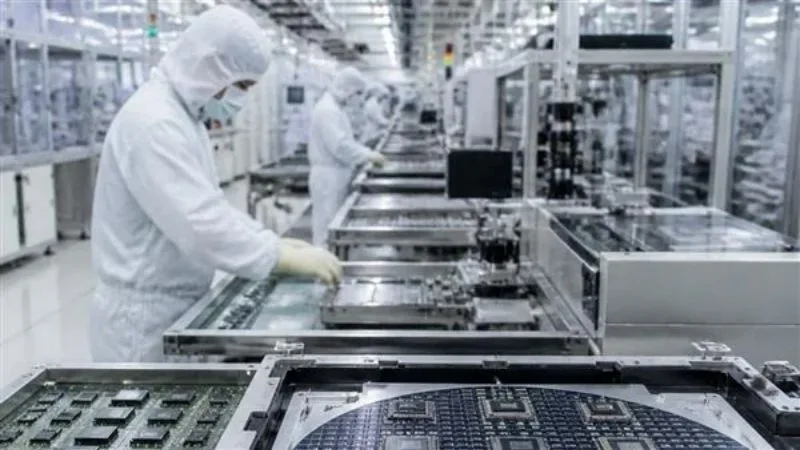
Siliconware Precision Industries Co (SPIL) has announced yet another multibillion-dollar deal with Nvidia in order to accelerate its manufacturing of high-end chips in Taiwan. It has been done in order to cope with the rapidly rising demand for artificial intelligence computing hardware and data centers globally.
According to the company statement, Siliconware Precision, which is part of ASE Technology Holding Co., will pursue an expansion program over multiple year. It aims at boosting its manufacturing of the advanced packages by a factor of three until the middle of 2029, thus allowing Nvidia to leverage its computing platforms.
For this purpose, SPIL will build a brand-new manufacturing lines that would be able to perform all the operations from bumping through assembly and testing. The company will modernize the existing production facilities, produce more interposer wafers and implement additional automated machines. Thus, the speed of delivery and logistics will increase significantly.
The agreement highlights the strategy of Nvidia to ensure manufacturing capacity. In the tech industry, there have been substantial supply problems with advanced packaging leading to delays in offering advanced AI solutions due to the large disparity between orders and factory capacity.
The expansion of SPIL is just one aspect of the larger effort made by Nvidia to expand their manufacturing capabilities, which was unveiled Tuesday. The American chipmaker is working with different suppliers in the supply chain to boost production at every stage of chip production from substrates to testing and assembly. Besides SPIL, other collaborators in this partnership include Amkor Technology Inc., Foxconn Technology Group, Kinsus Interconnect Technology Corp., Samsung Electro-Mechanics Co., and Taiwan Semiconductor Manufacturing Co. (TSMC).
Through the broader collaboration process, Kinsus Interconnect Technology revealed yesterday that Nvidia has pledged an investment of over 1 billion US dollars to expand its operations at its Taoyuan facility. This investment will ensure the long-term and stable provision of packaging substrates to support Nvidia’s new product range.
Due to the adoption of AI technologies by cloud providers, large enterprises, and emerging tech fields, there has been a significant rise in demand for premium substrates. Recent AI processors have become larger in size, number of layers inside, and have required complex substrates, hence increasing the pressure on global factory capacities significantly. As a response to the rising demand, Kinsus aims to increase the production of ABF substrates for Nvidia by over 3.5 times compared to the existing capacity level. The first production is scheduled for the second half of next year, while a second one will follow in Q3 2028.
As for Nvidia, the company provided an update regarding its collaboration with TSMC. Nvidia has announced that its Vera Rubin NVL72 systems and Vera central processing units, specially designed for agentic AI applications, were launched on mass scale in the third quarter of the reporting period. Vera systems are based on TSMC’s 5-nanometer and 3-nanometer production technologies and chip-on-wafer-on-substrate packaging.