
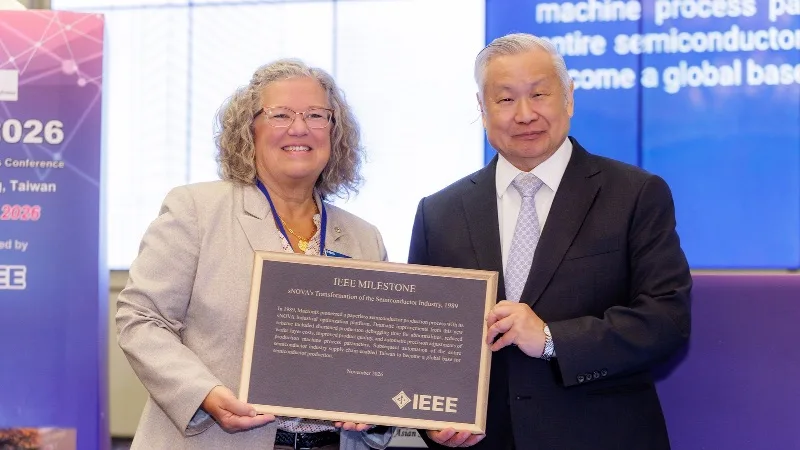
Macronix International Co., Ltd. has been awarded the IEEE Milestone Award for its proprietary industrial production optimization platform, the sNOVA system, marking the first time a semiconductor company in Taiwan has received this distinction. The recognition plaque was presented by 2026 IEEE President-Elect Jill Gostin to Dr. Miin Wu, Chairman and Chief Executive Officer of Macronix, during an official ceremony in Taiwan attended by Dr. Cheng-Wen Wu, Minister of Taiwan’s National Science and Technology Council (NSTC).
Developed by Macronix between 1989 and 1997, the sNOVA system established a paradigm shift in how wafer fabrication facilities monitor, analyze, and control manufacturing telemetry. In conventional fabs during the late twentieth century, process adjustments and yield diagnostics were largely manual, reactive, and documentation-heavy. Macronix addressed these limitations by integrating statistical models and algorithmic data processing directly into live cleanroom workflows, pioneering early artificial intelligence and big data concepts within semiconductor processing. The system automated precision adjustments of tool parameters, cut debugging cycles for process abnormalities, lowered wafer-layer manufacturing costs, and established what became the world’s first paperless semiconductor fabrication facility.
The deployment of sNOVA proved foundational in elevating commercial manufacturing quality for non-volatile memory (NVM). By fusing statistical analysis with front-end microelectronics engineering, Macronix transitioned device defect-rate tracking from standard parts-per-million levels down to the parts-per-billion threshold. Jill Gostin highlighted that sNOVA revolutionized the utilization and governance of engineering information, demonstrating how advanced computational architectures allow process engineers to decipher complex multi-variable interactions and make data-driven decisions before such capabilities became industry standard.
Beyond Macronix’s internal memory operations, the operational concepts embodied in sNOVA catalyzed the digital transformation of Taiwan’s broader semiconductor manufacturing base. Dr. Cheng-Wen Wu observed that Macronix’s pioneering integration of statisticians into wafer fabs established a blueprint that permeated the island’s foundry and supply chain ecosystem as technical talent transitioned across firms. The methodology helped scale production yields across Taiwanese wafer fabrication plants, directly supporting the region’s emergence as a dominant manufacturing hub for global computing silicon.
For today’s semiconductor industry, the core tenets of sNOVA remain central to front-end wafer fabrication and advanced packaging. As foundries deploy cutting-edge nodes and manufacture high-complexity artificial intelligence processors, multi-parameter statistical process control and machine-learning-driven yield analytics have become essential to managing sub-nanometer process drift. The IEEE Milestone formally recognizes how early digital manufacturing innovation transformed chipmaking into a high-precision, automated science that underpins the modern global electronics supply chain.