
India is on track to operationalize five semiconductor plants by the end of 2026, marking a critical transition from pilot demonstration to industrial-scale manufacturing. The announcement, made by Union Minister for Electronics and IT Ashwini Vaishnaw, confirms that of the 12 projects approved under the India Semiconductor Mission (ISM), three facilities have already commenced commercial production, with two additional units scheduled for commissioning in the coming months.
Sanand Emerges as an Advanced Packaging Hub
The commercial operationalization of three plants in Sanand, Gujarat, establishes the country’s first dedicated semiconductor manufacturing cluster:
Micron Technology: Inaugurated by Prime Minister Narendra Modi on February 28, 2026, Micron’s USD 2.75 billion Assembly, Test, Marking, and Packaging (ATMP) facility is actively producing DRAM and NAND memory packages for automotive, mobile, and data center markets worldwide.
Kaynes Semicon: Commencing commercial production on March 31, 2026 just 14 months after groundbreaking the OSAT plant shipped India’s first 900 multi-chip modules to Alpha & Omega Semiconductor in October 2025 and is ramping toward 6.3 million units daily.
CG Power & Renesas Electronics: Representing an investment exceeding INR 7,600 crore, the joint venture entered commercial production following a 27-month construction-to-manufacturing cycle. The plant manufactures specialized semiconductor packages for automotive, two-wheeler, and industrial equipment, exporting devices directly to Japan, Europe, and the United States.
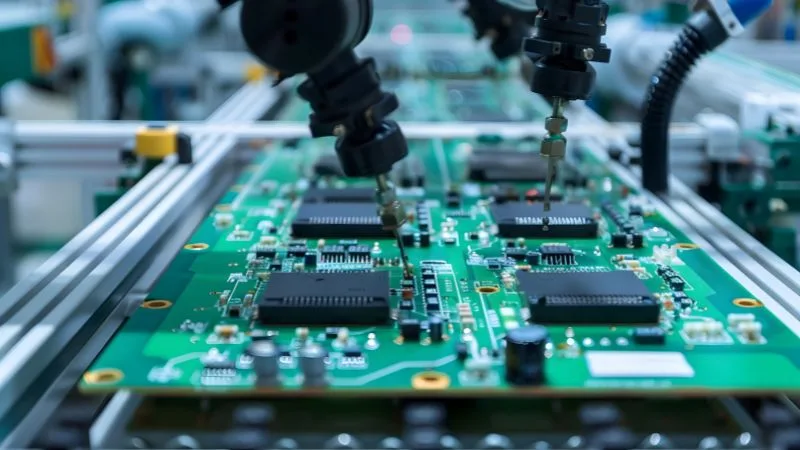
These packaging installations establish high-volume assembly lines while integrating specialized local talent, including women operators trained through dedicated programs in Malaysia.
Expanding Infrastructure and Front-End Scaling
Operating advanced backend lines requires rigorous facility engineering. Facilities in Sanand require precision cleanroom construction, ultra-pure water (UPW) delivery, tight temperature and relative humidity tolerances, micro-vibration isolation platforms, and specialized exhaust systems for chemical die-attach and wire-bonding steps. Production lines are certified to automotive-grade IATF 16949 standards, proving domestic facility capabilities to global tier-1 buyers.
Beyond packaging, the Tata Electronics–PSMC joint venture in Dholera is progressing toward first silicon by December 2026. This 300mm front-end fabrication plant targets 50,000 wafer starts per month across 28nm to 110nm process nodes.
Policy Expansion and Long-Term Ecosystem Outlook
To support this rapid buildout, the government disbursed INR 5,000 crore from initial ISM outlays and allocated INR 8,000 crore in the 2026–27 Union Budget. Under the forthcoming ISM 2.0 framework, policy support is expanding into semiconductor equipment, raw materials, and advanced design. Simultaneously, the Electronics Component Manufacturing Scheme approved 22 proposals worth INR 41,863 crore to scale local production of PCBs, camera modules, and passives.
International partnerships continue to deepen the supply chain. Intel CEO Lip-Bu Tan joined an agreement with the Government of Odisha to establish advanced packaging glass-core substrate manufacturing, expanding the upstream supply base. With 12 units under construction, 24 chip design startups active, and 70,000 engineers trained, India is anchoring its roadmap to become a top-six global semiconductor nation by 2032.