
Semiconductor gas delivery system manufacturer Rayzher stated it entered into a joint venture and alliance agreement with MESSER, a Germany-based firm specializing in both industry and specialty gases. The two companies will then form Messer Rayzher Electronic Materials Co., Ltd. to signify Rayzher’s venture in supplying and managing electronic-grade specialty gases to semiconductor manufacturers. This agreement was made between Chou Ku-hua, the Rayzher’s vice chairman and COO, and Huang Fu-sheng, the vice president of global product management of MESSER’s Electronics Business Unit. Liang Chun-wei of Saint-Germain Group served as the witness together with Ma Wei from Novatech.
This particular business relationship means a lot more to Rayzher than just the launch of a new product line. Historically, Rayzher had concentrated primarily on providing the engineering services associated with the construction of gas supply systems for Taiwanese chipmakers and had installed the piping required there as well. As the result of this new endeavor, the company is entering the area of specialty gas materials and operation management, rather than the construction of the facilities for its customers. This particular joint venture marks a turning point for Rayzher as a traditional facility contractor and material provider.
MESSER will be responsible for the day-to-day management of the joint venture activities, and Rayzher will be the equity partner in the joint venture. The two partners have shared their roles based on their respective strengths. While MESSER will be responsible for manufacturing upstream ultra-high-purity and electronic-grade specialty gases and managing the logistics chain globally, Rayzher will be responsible for business development in the semiconductor industry in Taiwan, gas operations, and on-site local services by providing seamless gas delivery to factory operations.
The company was established in 1898 and is headquartered in Bad Soden, Germany. It has operations in 30 different countries and has been supplying critical materials to global chip manufacturers. Huang pointed out that even though MESSER had an excellent international reputation, Taiwan – one of the most important centers for chip manufacturing in the world – had been missing from its local service network. This joint venture fills up that gap. He said that the two companies complement each other without overlapping since MESSER has an excellent global product line and gas purification technology and Rayzher has strong local customer connections, piping engineering, and on-site safety knowledge.
Notably, the joint venture is currently targeting major international markets including America, Singapore, and Malaysia. Liang said the joint venture seeks to package the gases and materials to be supplied to Taiwanese companies in the tech industry as well as to other rapidly developing sectors like co-packaged optics, advanced packaging, central processing units, electronic components, and optical communications. Notably, emerging co-packaged optics manufacturing is a sector that uses large quantities of gas and this will assist the Saint-Germain Group in addressing deficiencies in gas and valve components.
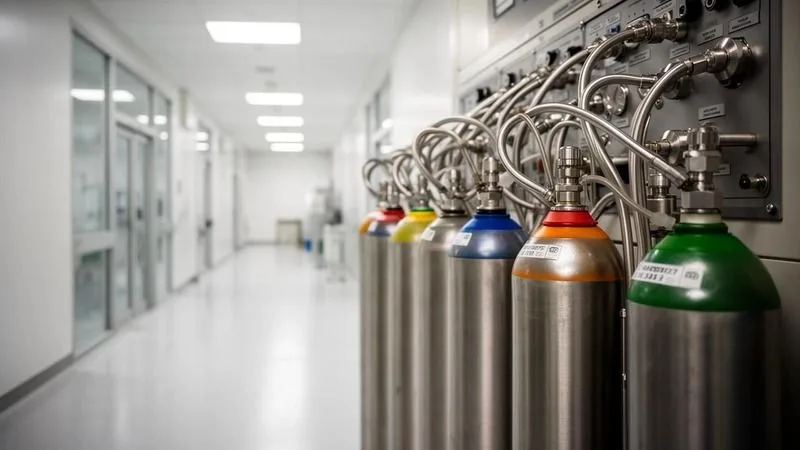
Initially, the new business will involve the sale of specialty gases from MESSER while setting up gas filling stations in Taiwan as well as the whole of Asia which will involve huge storage facilities near customers’ plants. After this process, the venture will move ahead to begin local production of gases. The services offered will not stop at just construction of the factory but rather the joint venture will provide long term provision of gas, equipment servicing, and maintenance. This is because of the hazardous nature of specialty gases which require skilled handling.
The growth in demand is primarily driven by the ongoing expansion in factories for the manufacture of chips and new technologies such as CoWoS, which require larger amounts of different kinds of gases. As reported by Chou, geopolitical tensions in the Middle East region earlier this year created concerns about a shortage of helium. The importance of reliable supply chain has never been clearer than now. The current Taiwanese suppliers have limited capacity and overseas presence.
Specialty gases being directly used on silicon wafers in manufacturing processes have to go through rigorous customer testing and certification prior to being embraced by the factories. Rayzher has begun talks with some leading semiconductor manufacturers that showed great interest and will rely on MESSER’s industrial knowledge in order to quicken the process. In terms of investments, the collaboration will not immediately increase profits, since it all depends on how fast clients will be able to certify the specialty gases. However, after the specialty gases are approved for manufacturing in large scale, contracts with customers on gas supply become rather stable and long term. In light of the fact that Rayzher already has its offices in the United States, Japan, Germany, and Singapore, collaboration with MESSER will provide the company with an additional steady source of income.