
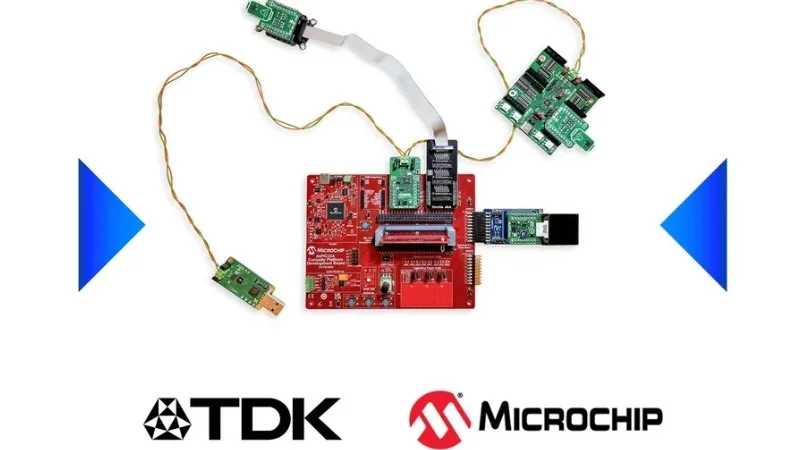
TDK Corporation and Microchip Technology Inc. are demonstrating a distributed sensor-node platform for next-generation robotic systems at electronica, Munich, this week (TDK booth B5.520). The new platform combines sensing technology from InvenSense, a TDK group company, with Microchip’s dsPIC33A Digital Signal Controller (DSC) and LAN8651/LAN8679 based 10BASE-T1S single-pair Ethernet connectivity for real-time intelligence and edge AI processing for robotics applications.
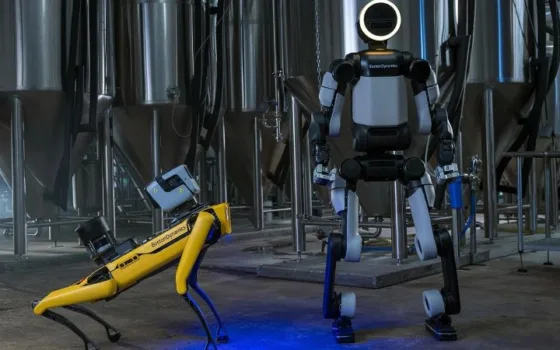
Today’s humanoid robots may incorporate 100 or more sensors, as robots increasingly rely on sensors for smart perception, motor control, force and torque measurement, joint monitoring, safety and environmental awareness. The new Microchip + TDK platform is designed to help robotics developers integrate a greater number of intelligent sensor nodes throughout a robot, while also simplifying cabling and communications and increasing sensor-enabled perception. By processing sensor data locally at the edge on the dsPIC33A DSC, the solution can reduce latency, network traffic, and the computational workload of the robot’s central controller.
“We’re partnering with Microchip to help solve a real need for our customers, which is how to easily integrate a multitude of sensors along with the dedicated, distributed processing capabilities that enable fast local intelligence,” said Massimo Mascotto, director of product marketing for InvenSense, a TDK group company. “With use of the Microchip + TDK sensor platform, robotics engineers can achieve more efficient motor control and smoother, more human-like robotic movements.”
The new platform’s demonstration board combines a Microchip dsPIC33A DSC, LAN8651/LAN8679 10BASE-T1S connectivity, a TDK InvenSense ICM-42688-P 6-axis inertial measurement unit (IMU), and a MikroE expansion connector for compatible additional TDK sensors. The Microchip dsPIC33A DSC can process and fuse the InvenSense IMU data locally before transmitting relevant information over the 10BASE-T1S network. Further, the MikroE expansion connector enables developers to evaluate compatible additional TDK sensors and configurations, such as the recently launched InvenSense PositionSense 9-axis solution for absolute orientation detection.
Microchip dsPIC33A DSC key features
The Microchip dsPIC33A DSC combines a 200 MHz 32-bit core, DSP acceleration, and a double-precision floating-point unit with high-speed ADCs and high-resolution PWM capabilities. These features support demanding real-time sensing and control applications, including:
- Sensor fusion
- Digital filtering
- Vibration analysis
- Force and torque processing
- Motion and joint monitoring
- Condition monitoring
- Real-time control loops
- Edge AI and machine learning
For robotics applications, the dsPIC33A DSC runs machine-learning algorithms for real-time gesture recognition using data from multiple sensors. This illustrates how distributed T1S-connected sensor nodes can support intelligent sensing and edge AI applications. The dsPIC33A DSC processes sensor data locally, allowing each node to perform acquisition, signal conditioning, filtering, sensor fusion, diagnostics and machine-learning functions before transmitting relevant information to the central controller.
TDK IMU key features
The InvenSense SmartMotion® ICM-42688-P is a 6-axis IMU combining a 3-axis accelerometer and a 3-axis gyroscope. Integrated with the Microchip dsPIC33A DSC, the IMU can support robotic applications such as:
- Robot orientation and proprioception
- Joint-motion monitoring
- Motion stabilization
- Vibration monitoring
- Gesture recognition
- Distributed condition monitoring
- Positioning and articulation
- Autonomy and safety
Additional TDK sensing solutions for smart perception in robotics will be demonstrated at electronica, Munich, November 10–13, TDK booth B5.520; these include TMR and Hall sensors for ultra-precise angle detection; MEMS microphones for acoustic activity detection; temperature sensors for environmental monitoring; pressure sensors for tactile sensing; and 9-axis IMU+TMR sensing for exact location and orientation detection.