
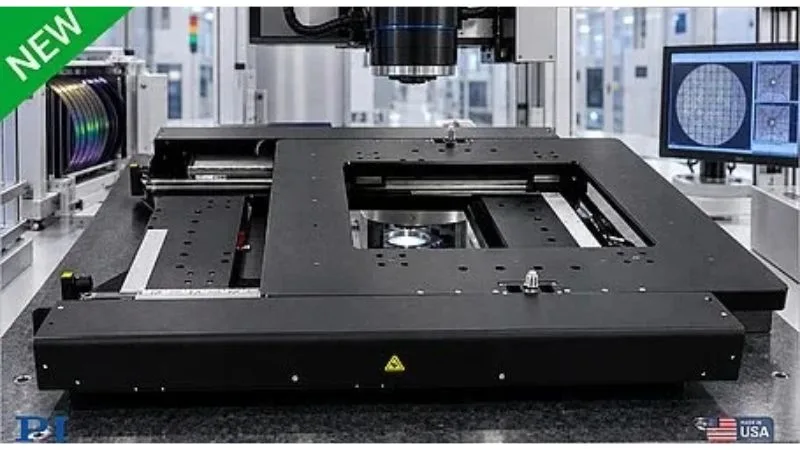
Chip manufacturers are designing their semiconductors with smaller structures, tighter tolerances, and increased speeds in manufacturing. Due to these needs, the motion systems within wafer inspection and metrology equipment require higher levels of accuracy and speed. To meet these needs, Physik Instrumente, or PI, has launched the V-783 planar XY stage. The stage is designed and made in the USA and offers high accuracy, high geometric stability, and fast movement.
Planar XY Construction for Enhanced Stiffness and Reduced Height
Typical positioning stages tend to position one axis on top of another. However, unlike the typical stacked construction, the V-783 relies on an integrated planar XY construction. The design is capable of reducing the height of the stage while increasing the width of the bearing and mechanical stiffness.
The increase in mechanical stiffness and the width of the bearing is capable of lowering geometric errors within the full range of travel. This is important for applications like optical inspection, wafer mapping, and surface measurement.
High Speed, Fast Settling, and Shorter Cycle Times
Each axis in the V-783 is powered by two ironless three-phase linear motors. Since there is no iron core in the direct-drive motor, there is no magnetic cogging effect and the movement is smooth without any backlash. With the help of ACS NanoPWM control algorithm, the system is able to deliver good dynamics as well as fast step and settle performance. Fast acceleration and high speed enable quick movement between measurement points.
Performance Specifications
The V-783 comes with a series of performance specifications that suit challenging inspection and metrology configurations:
- Travel and clear aperture: Travel of 310 by 310 mm of XY travel with a 360 by 360 mm clear aperture.
- Resolution of encoder: Encoder resolution of 1 nm with incremental Sin/Cos feedback or absolute BiSS-C feedback.
- Repeatability: Repeatability of plus or minus 0.07 micrometers in both directions for reliable positioning in repeatable sequences.
- Accuracy: Positioning accuracy calibrated to plus or minus 0.17 micrometers.
- Straightness and flatness: Straightness and flatness of 0.75 micrometers to minimize errors caused by motion during scans.
- Velocity and acceleration: Maximum velocity of 1 meter per second and maximum acceleration of 10 meters per second squared.
- Load capacity: Load capacity of up to 50 kilograms, providing space for inspection optics and sensors.
Designed for Automated Semiconductor Metrology and Cleanrooms
The V-783 has been designed for semiconductor metrology and inspection systems that can move precisely from one measuring point to another. Typical applications include wafer surface inspection, optical metrology, defect inspection, and dimensional measurement.
If used in conjunction with an absolute encoder option, the stage will provide accurate information about its position immediately after turning on the power. It eliminates the need for a homing procedure, reduces the start-up time, and simplifies the integration into automated production lines. The frame is made of hard-anodized aluminum to be suitable for cleanroom use.
Integration of Controllers and PI Overview
For the control of the system, the V-783 works with PI’s A-81x and A-82x series of ACS-based EtherCAT motion controllers that provide coordinated multi-axis motion. The mentioned controllers are incorporated in automated semiconductor systems and employ PI’s PILOT algorithm to enhance dynamic performance while reducing motor currents and heat generation.
Physik Instrumente is an international supplier of solutions in the area of motion control, nanopositioning, and automation. Having over 50 years of experience, Physik Instrumente manufactures standard and customized systems for original equipment manufacturers and research organizations in the field of photonics, semiconductors, laser, medical and life sciences, aerospace, and scientific research. Product lines of Physik Instrumente include piezo materials and actuators, air bearings, precision positioning stages, hexapods, and automated photonics alignment systems.